|
|
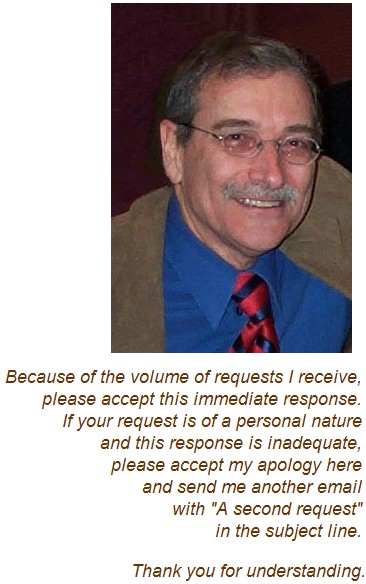
The Reverend Vern Barnet, DMn
bio page CRES minister emeritus vern@cres.org
RESPONSE #83
Interfaith Ministry Training
Dear Inquirer:
It is difficult for me to recommend unaccredited schools for interfaith ministry.
My concerns are several.
1. Some institutions focus on what is thought to be common to all or most faiths when in my opinion faiths are best approached with openness, to appreciate their differences. Only by a mature comprehension through lived experience can deep similarities be considered because they are not obvious to the novice, and a superficial approach to similarities is misleading.
2. Book-learning and lectures are insufficient for interfaith ministry. Actual supervised intern experience with at least several different faith groups would be as important as mastery of scholarly material.
3. Much that is written about various faiths in popular books is incorrect. Academic competence in fields such as psychology, world history, American religious history, sociology, theology, education and religious phenomenology should be required as preparation for interfaith ministry. Further, active membership in organizations such as NAIN or the IARF are valuable.
4. In addition, skills in teaching, communication arts, group process, and negotiation and mediation are essential.
Such preparation should be regarded as graduate work.
I recommend seminary work at Harvard Divinity School, the University of Chicago Divinity School, the Hartford Seminary, and the Gradauate Theological Union at Berkeley where it is possible to obtain both the knowledge and the skills to do interfaith ministry. In addition, local seminaries can provide a good portion of training to which, if practical and supervised experience is added, can become the basis for interfaith ministry. I also recommend the Interfaith Academies, in cooperation with Harvard's Pluralism Project and Religion for Peace-USA, which, while an insufficient course, provides enough exposure to the problems and opportunities of interfaith work to inform one of whether to pursue a more thorough course of training.
It is also true that in some professions, such as hospital chaplaincy, one begins where one is and learns through experience.
5. Finally, I do not understand how a person can be ordained into interfaith ministry any more than a person can decide to speak without selecting a particular language in which to speak. It is wonderful if we can speak several languages, and it is wonderful if we can be comfortable in several faiths. And there are cases where persons have been ordained in two or more traditions. But I cringe at "interfaith ordination" because to me it sounds like pabulum.
While I myself do interfaith ministry, I was ordained in a particular tradition which in no way inhibits me from participating in the singular character of other faiths, any more than having a painting by Rembrant in my home prevents me from being profoundly moved by paintings by Mu Ch'i or Picasso. But I would hate to have them mangled together into one picture.
This said, I recognize that a number of friends have benefited greatly from their experiences at unaccredited interfaith instititions. As the field matures, my reservations will become less important.
Each person has special backgrounds, energies, and resources. Please accept my gratitude for your interest in doing interfaith work, whether or not you seek ordination or certification. There are many ways to be involved locally with over two dozen organizations in the metro area, and certainly including CRES.
6. A realistic comment about my own financial experience can be found by clicking here: 33_Interfaith_Employment.htm
Vern BarnetDRAFT
Certification in
Interfaith ConsultationA proposed program of
academic and practical training
Why a Certificate in Interfaith Consultation?
Clergy and other religious leaders, educators, civic volunteers, resource managers (such as librarians), business leaders (such as corporate HR officers), and committed lay people increasingly encounter religious diversity and want to recognize the importance of the many faith traditions in personal and community life.
Certification involves uplifting and honoring the distinctions of each religion. This program eschews attempts to merge or diminish them, and abhors attempts at conversion and insists on protecting the integrity of each faith. The goal is to increase understanding and build relationships of mutual regard.
This certification program provides both information and skills training to work with those of many faiths in a wide variety of ways —
community development
curriculum planning
workplace mediation
organizational development
interfaith ministries
The Certificate is good for three years and may be renewed by a refresher course or review of one’s interfaith activities. Those with certificates are encouraged to meet together regularly to benefit from sharing their experiencesPrerequisites
The program is equivalent to a Masters Degree, though academic coursework may be done at the undergraduate level. However, the certification is a professional rather than an academic recognition. The applicant should have an undergraduate degree or its equivalent in life experiences, strong intellectual abilities, emotional maturity, and a background of involvement in a community of faith.Curriculum
Coursework must be completed at accredited institutions or the applicant must demonstrate competence in at least these areas of content learning and skills training:1. World history
2. Western religions survey
3. Asian religions survey
4. Religion in American society
5. A theme course in religious studies such as medicine and religion, religion and the arts, politics and religion, gender studies, and religious ethics.
6. Psychology and/or sociology of religion
7. Issues of religious pluralism
8. Teaching skills and communication arts
9. Group process skills
10. Negotiation and mediation
The Practicum, Examination, and Thesis
A supervised practicum provides the applicant an opportunity to serve a specific faith community, several faith communities, or the community at large while still in the training program. The applicant must propose a specific project advancing interfaith understanding, apply appropriate resources, and demonstrate skills at a level generating the respect of those involved in the project.
In addition, a concluding thesis reflecting upon the practicum should integrate one’s personal approach to faith issues with the course work and contribute to the field of interfaith work.
A final oral examination based on the thesis provides the applicant an opportunity to demonstrate presentation and interaction skills as well as knowledge gained from the program.Application
A letter of application should explain why one wishes to be an interfaith consultant, provide relevant background, and suggest how one would use the Certification in advancing interfaith understanding. Acceptance requires a two-way interview.Local institutions offering some appropriate course work
Avila College
Central Baptist Theological Seminary
Johnson County Community College
Nazarene Theological School
Ottawa University — Kansas City
Park University
Rockhurst University
Saint Paul School of Theology
University of Kansas
University of Missouri — Kansas City