|
|
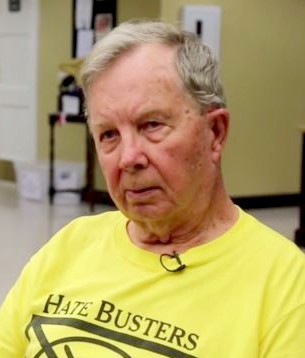
Ed Chasteen
CRES amity shaman
Ed's blog and stories: http://hatebusters.wordpress.com/
email: HateBuster@aol.comwebsite:www.hatebusters.com
update:
http://www.voanews.com/a/hatebusters/3837542.html
|
1-2-19 by Ed Chasteen Measured by money, I’m not. But that’s not my measure. Seems to me that the purpose of life, at least of mine, is to meet every person I can and expect to like every person I meet. I’m rich because I measure my life by this: My Belief
My Motto
My Practice
My Dream
My Address
*Not all faiths could be named. ALL are included.
TABLE OF FAITHS 2021 Prelude In 1947 Mother and Dad took us three kids to the Yale Theater in Cleburne, Texas, our hometown, to see Spencer Tracy in a movie set in 1936 Germany just as Hitler has come to power. Seven crosses have been erected in a prison yard. Six of them are soon filled with escapees Hitler imprisoned for opposing his policies. The movie is the story of that seventh cross and the escapee, never caught, it was intended for. By 1951 all five in our family have been living in Huntsville, attending First Baptist Church for three years. It’s near noon on a Sunday morning. Brother Clinard has just concluded an elegant-eloquent sermon explaining how and why we should all love one another. Heaven had come to earth. It lasted maybe a minute, until I overheard those two men at the church door. One said to the other, “If them niggers try to come in this church, I’ll beat ‘em back with a baseball bat.” The other replied, “Me, too.”
In 1954 I graduated from Huntsville High School and walked to our local
college bookstore. A book, The Negro in America, grabbed my attention.
Here was somebody trying intellectually to understand the social-spiritual
problem I’d overheard in church. The bookstore clerk told me that book
was for a class called Race Relations in the Sociology Department. “That’s
my major,” I told that clerk. I enrolled that day.
My Life in Liberty In 1965, I came to Liberty with my wife and three small children. We had all spent the previous year in Kansas City. The Department of Sociology at the University of Missouri in Columbia had given me a fellowship to study the Civil Rights Movement in KC. When I wrote my dissertation, Public Accommodations: Social Movements in Conflict and MU awarded my PhD, the five of us came to Liberty where I joined Earl Whaley in the two-man Sociology Department. Earl was my colleague at the college and became also my pastor when all five of us joined South Liberty Baptist Church. Our three children grew up with Earl as pastor, and when they went to Jewell, knew him as professor. In 1976, I got a three-year grant from the American Baptist Church to start an Ethnic Activities on campus. As the final event of every semester, we began the Human Family Reunion, where who’s right is the wrong question, everyone gets three-minutes to speak, eat first, ask later is our dining rule and no one says a discouraging word. And I wrote How to Like People Who Are Not Like You. This book was called in a review, “profoundly simple and simply profound, a formula for building Human Beings. By 1980, with the children as students at WJC, Bobbie
and I moved our membership to Second Baptist Church, just one block east
of campus. In business meeting one night in the fall of 1985, 2BC elected
me to be Ambassador from Second Baptist Church to Other Communities of
Faith, giving me the privilege and authority to invite other faiths to
our church and take our members to visit other faith communities, always
understanding that our sole/soul agenda is to find friends of other faiths,
against that time when tensions arise and we all need friends.
When Dub Steincross was pastor of Second Baptist Church, he would describe the one-square block on which our church stands as “this little piece of God’s good earth.” My mind quickly expanded a block east to include the campus of William Jewell College, both started by Baptists. When Jewell Hall was not finished on time, the first college classes had been held in the church. When I had ridden 125 miles on my longest cross-country days, the definition of this little piece of God’s good earth grew accordingly to include all places within 125-miles in all directions from Liberty and acquired Greater Liberty as a name. The name of a principle as well as a place, the principle being the Greater Liberty we all have to live above and beyond the labels others apply to us and we somehow just assume. In the fall of 1988, the people of Louisiana elected a KKK member to their state legislature and my students started HateBusters. The Louisiana governor invited us to come, as did a Black church and a White church in Baton Rouge, the state capital. We went. Word got out. We began to be invited everywhere by everybody. So it seemed. I got too busy for other faculty duties. In 1995 I left the college to make HateBusters a 501 C-3 non-profit. Headquartered in Liberty, we promise never to say no to any victim of hate. Whatever they say they need, we provide, free of charge. We have little money. We broadcast the need. The money comes. In 2004, WJC asked me to teach United States Pluralism, and I went to the Greater Kansas City Interfaith Council (GKCIC) to ask that they let my students become them for the semester. By consensus, they agreed. One by one, members of the GKCIC came to class and told their story. Students visited in council member’s homes and places of worship. Students wrote the autobiography of their person, sent it to their person for approval, then to me. And we held a concluding Human Family Reunion. In 2013, I became Custodian of Sapphire College, a place that exists in my head and online. Our sole purpose is to acknowledge those striving to become World Class Persons and receive our WCP: degree. I wrote a book about this place and its purpose. This book is available to all who ask at hatebuster@aol.com 2020 was lost to the pandemic. HateBusters had taken members and friends of 2BC to every Table of Faiths until COVID came to make our gathering unwise and dangerous. We did not meet. Planning for the 2021 Table of Faiths was done in springtime, when caution was required. So, a virtual ToF was planned for Thursday, September 23, to be watched on screen from 6:30-7:30 wherever viewers might choose, appropriate snacks prepared and distributed by the GKCIC. As Custodian of Sapphire College, leader of HateBusters, convener of the Human Family Reunion, aspirant for WCP status and Ambassador from 2BC, I invite 50 fully-vaccinated folks to email me their plan to come on Thursday, September 23 at 6:30 PM to 2BC at 300 East Kansas Street. We will eat the snacks prepared by the GKCIC as we watch the on-screen program they prepared. After watching the video, we will linger at our tables for a second hour to talk, and perhaps become interfaith friends.
Ridin’ Bikes and Bustin’ Hate
©2019 by Ed Chasteen Mother bought me a second hand bicycle in 1945 when I was nine years old and, though she herself had never ridden, taught me to ride. She took me to church from infancy on, where I learned about loving and defending people. One morning when I was 15, I heard my pastor preach a sermon that I just knew would make everybody in our town love everybody. As I walked toward the door, I knew that heaven had come down to earth. As I walked between two men who had just heard this sermon, one said to the other, “If them niggers try to come in this church, I’ll beat ‘em back with a baseball ball.” “Me, too.” Said the other. Like neon in the night, these 19 words have blinked in my mind ever since. I graduated May, 1954 from high school, the very month the Supreme Court of the United States unanimously (9-0) reversed the 1896 Plessy vs Ferguson decision and declared segregation of public schools unconstitutional. I walked two-weeks after graduating across our town to our local college and wandered over to the bookstore. Other than the conviction that I had to go to college, l had no clue what I was doing. No one in my family had ever been to college. Mother had planned to go. Her dad said only scarlet women went there and refused to let her. So, Mother graduated high school in May 1931 and married Dad in December. She did not invite her parents. I never knew my two sisters, born before I was. One lived long enough to get a name. The other did not. The umbilical cord was around my neck at birth, but I survived. I was to be Mother’s surrogate. That day in the college bookstore, I found a book
that would direct my life and sits today on a bookcase shelf behind me
as I type these words. The title caught my attention: The Negro in America.
The image of those two men in church flashed through my mind. Here in this
book, I thought, someone is trying to figure out intellectually the spiritual
problem I saw in church that day. I thumbed through the book. It was a
condensation of Swedish economist, Gunnar Myrdal’s two-volume classic An
American Dilemma funded by the Carnegie Corporation from 1938-1948 This
little green book in my hands was written by Arnold Rose, Associate Professor
of Sociology at Washington University in St. Louis, Missouri. I took that
book to the lady at the cash register. “What major is this book for?” I
asked. “Sociology,” she said. “That’s my major,” I said, though I had never
even heard the word. I was hooked by Gunnar Myrdal’s last two paragraphs
in his FOREWORD, quoted in Rose’s book. I bought the book.
“The Negro problem was not ‘solved’ in the study, as it is not solved in American society. The soul-searching process continues after the war, and this condensation appears primarily as one response to the need of Americans to find out what they are doing to Negroes and, as a consequence, to themselves. I do not believe that those white and Negro Americans, who are striving to give more of reality to the democratic creed of the American civilization in its application to the crucial Negro problem, need to feel discouraged. The long trend in American history is, in spite of temporary periods of reaction, a continuous development towards liberalism and democracy.
Just a year earlier, in January 1963, this same Sociology Department at the University of Missouri had rejected my application for admission. My previous attempt at a Sociology doctorate at the University of Texas had not ended well, when the new department chairman and I did not see the field the same way. I decided I would never win his approval. So, I went looking for a program I liked at a price I could afford. Noel Gist taught Race Relations at the University of Missouri, and MU did not charge out-of-state tuition. I had used Gist’s book in the class I taught at Southwest Oklahoma State College. But without a PhD, my future in higher education was insecure. When MU said my scores on standardized test were “not indicative of a high level of performance” and rejected my application, I was devastated. And mad. I wrote a nasty letter to that committee. Then tore it up. The issue was closed. No response was required. But I needed closure. On my terms. So, I wrote a second letter, one I did mail: “Gentlemen, in so far as my scores do not indicate what I can do, I am sorry. I know what I can do. I regret that I will do it elsewhere. I regret that I will not learn from you and we will not learn what we together could have done.” To my surprise came three letters from that committee over the next month. The first letter said they were reopening my application; the second said they were admitting me on probation; the third asked me to teach a social problems class for freshmen students when I came. In April 1964, the city of Kansas City, Missouri held a city-wide vote to decide if the City would continue its practice of denying black people the use of public accommodations. I moved to Kansas City in May 1964. The outcome of that vote had been decided. The organizations on various sides, the people who gave them voice, the rationale they used, their strategies in getting out the vote: these were unknown to me. I wanted to know. Over the next 12 months I interviewed hundreds of people on all sides of the issue. I analyzed census records and voting districts to determine which parts of Kansas City voted to retain this discriminatory practice and which voted to change this legally sanctioned practice. I did this to test several hypotheses advanced by Gunnar Myrdal in An American Dilemma, which by this time I knew to be the landmark study of American race relations, headed as it was by a purposely chosen non-American, in order to avoid the unconscious bias inevitably absorbed by anyone growing up in this country. A person like me. When after a year, I had written my dissertation, Public Accommodations: Social Movements in Conflict, I was free to leave Kansas City and return to my Oklahoma college. But I had met so many people and learned about so many community problems. I could not abandon this place. I would never know what was to happen. I could play no part in deciding the future of these people in this place. When a faculty position in the Sociology Department of an area college came open, I applied and was hired. Among the courses I was to teach at William Jewell College was Race Relations. I’d been teaching this class for 23 years when one morning in 1988 I read in The Kansas City Star that the State of Louisiana had elected a member of the KKK to their Legislature. With that newspaper in my saddlebag, I rode my bicycle by the shortest route to campus. I held the paper up to my Race Relations students. “Class, I’ve always told you it’s never enough just to know about a problem. If we know, we have to act. Now that we know these folks in Louisiana have been embarrassed, we must help them. But I have no idea how. Together, we’ll figure it out. First, though, we need to know why we have to help. Our college was founded by a church. Maybe that’s a clue. We are a small college in a little town near a big city smack in the middle of America. Most folks who live in Louisiana don’t know we exist and have no reason to feel disappointed if we don’t help.” But we would know. And we could not live with ourselves. This was our conclusion after only a few minutes of discussion: We had to help. What, when and where took longer. Much longer. We rambled. We sat. Lost in thought. Then, from the back of the room came a voice, “Let’s go to Baton Rouge.” By unanimous unspoken assent, we immediately knew where. But how to get there? We had no money. How could we all go? If not all, who? The bell rang. Time to leave. Weeks, then months, went by, a few minutes from each class devoted to our Louisiana mission. We started HateBusters. We designed a T-shirt to wear. We wrote a theme song. We elected a black student, a white student and me to go. We asked American Airlines for three free tickets. They said yes. I asked a well-connected friend in KC from Public Accommodation days to ask the governor of Louisiana to invite us. They both said yes. A local black pastor asked his old seminary roommate, then a Baton Rouge pastor, to host us. He said yes. It had taken us a year to get everything in place. Student members of my class had changed. The whole campus knew. We arrived in Baton Rouge on a Thursday in April 1989. I went home with a black professor of Sociology at LSU, who was also a member of the black church that hosted us. Both students went home with a white business owner, who, as we left on Sunday, took us all to lunch. We spoke at LSU. We were interviewed by local radio, TV and newspapers. We had a crawfish boil in a deacon’s back yard on Friday. The Governor declared Saturday & Sunday to be HateBusters/Human Family Reunion Weekend. We had an all-day Saturday bicycle ride drawing hundreds from the steps of the state capital out along the banks of the Mississippi River through small towns, inviting folks to join us that evening for the Human Family Reunion at Shiloh Missionary Baptist Church, our host. We got more PR for the good guys than the bad guys got. I had tried when we first got here to meet the KKK member who started this all. Off the record. Just the two of us, so we would know each other. He would not. Word got out. We began to be invited most everywhere by most everybody. We got too busy. We could not keep up. So, I took HateBusters off campus. No longer did I have time for classroom obligations, so HateBusters became a 501 C-3 non-profit with headquarters in my Liberty home and my office for meeting folks in one of the dozen or so small town cafes within bicycle distance, usually Ginger Sue’s at 12 W. Kansas Street in Liberty, two-and-one-half miles from my home. I was diagnosed with Multiple Sclerosis in May, 1981, and warned I’d soon be an invalid, told to rest and not get hot. In May 1987 I got on my bicycle at Epcot Center at Disney World in Orlando, planning to ride, alone and without money, to Seattle, then down to Anaheim—Disney World to Disneyland—by way of Seattle: 5,126 miles in 105 days, counting on the goodness of strangers to make it work. If I made it, I would prove that doctor’s prognosis wrong. My MS would mean I must be active. And I would prove true what I had learned in church: God is love. God is all knowing and all powerful. We are all created in God’s image. We must, therefore, have at least a spark of goodness and genius within. At the moment of our meeting, that spark would spontaneously combust into a flame to light our way and warm our hearts. Such was my hope. With a calling card given to me by AT&T, I called the campus every day so they could move the peg to the place on the map on the campus billboard to show where I was when I called. Every Sunday morning, I called the pastor of Second Baptist Church in Liberty to tell him the name of the religious community hosting me for the weekend, a message he relayed to the congregation. When I got to Disneyland, Mickey Mouse and all the Disney characters held a parade just for me with a red-carpet ride up Main Street and my name on the marque out front for all to see. They dubbed me the Pedalin’ Prof. Mickey gave me a trophy, a ceramic replica of himself on a wooden base with a brass plate reading: HONORING
On my longest days across the Wyoming, Montana, Idaho mountains and the high plains desert of Washington State, I biked 125 miles into an infernal, incessant, howling wind, always in my face. Wind River, Wyoming is aptly named and applicable for hundreds of weary miles. When I was home again and out of the wind, my mind turned to the description of our church long ago used by our pastor to describe the one-square city block occupied by our church: “This little piece of God’s good earth.” Liberty is the name of our town. I rode 125-miles on my longest days. So, I drew a 125-mile circle around our town and dubbed this place Greater Liberty, a place that immediately also became the shorthand expression of the principle by which and upon which HateBusters operates: The Greater Liberty we all have, though few realize it, to live above and beyond all the labels other folks apply to us and we uncritically assume, labels such as race, religion, gender, nation, class, conservative, liberal, etc. Applied to any person, all adjectives limit the soul, the essence. People are not meant to be compared, each is his or her own standard. A variation of the same question always came up in every place I rode through that summer on my bicycle. What’s the best place you’ve been? The most memorable person you’ve met? At first, I didn’t know how to answer. I quickly learned. This is the best place. You are the most memorable person. Any other answer sets up a competition between places and persons and diminishes the value of this present moment. A Liberty newspaper reporter gave me a camera to send pictures back home from my ride. It was buried inside the clothes I carried in my panniers and was never convenient at the moment I thought of it. When every place and every person seemed to warrant a photograph and attempting such would monopolize the short time we had to breathe our spark to life, I decided to take pictures only with my eyes and put the people and places of that day into words before sleep that night. I ride now in Greater Liberty: an area going north to Creston, Iowa and south to Carthage, Missouri; west to Manhattan, Kansas and east to Columbia, Missouri. Even this small an area is hard to regularly manage, so I have devised an Inner Sanctum, a dozen or so small-town cafes within 25 miles, one of which I usually visit on a normal day. Not only is my riding good for my physical health, but also for my mental and spiritual. I get more ideas aboard my bicycle than ever come to me at my personal computer in my office. Small town cafes, where at anytime the owner may be present, constitute the life blood of any country. To become an occasional-regular in several is as near to secular-heaven as anyone can reasonably aspire. To be so blessed in life is the unmerited good favor drawn up for me by seemingly random events put together over vast stretches of time. For some unknown reason my life seems to follow a theme I find in Man of La Mancha and Les Miserables. Don Quixote’s friends want him to quit and advise him that “wickedness wears thick armor.” And for that you would have me surrender? Nay, the enchanter may confuse the outcome ten -thousand times, still must a man arise and again do battle, for the effort is sublime.” And when the priest lies to the police and Jean Val Jean is thereby, for a reason he never learns, made free and rich, his life acquires a purpose unimaginable to him before, prompting in me a negative response to Emily’s question in Our Town: “Does anyone ever realize life as they live it, every single minute?” The ultimate meaning of any one thing can only be known in combination with things that happen on down the road. Sunday, June 7, 1987 I am in Nashville, Tennessee on my cross-country bike ride and have just confessed to a church Sunday School class that I have a grade school understanding of my ride’s purpose and need a grad school knowledge. A member of the class stands, of his own volition to sing: “Farther along, we’ll understand why.” It’s Wednesday, July 22, six weeks later, when I reach Fourth of July Pass between Kellogg, and Couer d’Alene, Idaho. When I learn that the Aryan Nation’s headquarters is close by Coeur d’Alene, I get to the newspaper as deadline approaches and wait for an hour to see what I can help make happen. When he is free, Gail Wood and I sit for half-an-hour or so while he takes notes. Gail seems sympathetic but can’t grasp how people of different faiths can get together without trying to convert one another. He asks if I think it’s important to share Jesus Christ with Yahya Furqan, a Muslim imam, who heads up my interfaith support team in Kansas City. I say no. That’s such a crucial part of the Human Family Reunion. It cannot ever, even for a moment, be seen as a platform for converting folks from one faith to another. Who is right is the wrong question at our HFR. It does not come up. To make this point is my reason to ride, a point that comes clear to me here where hate has taken root. So hate cannot win. This is why I ride. And
write.
Letter to Cassidy from Ed Chasteen 2018 Dec 31
The four of us are seated in a booth, Vern and I on one side, Anton and
Michael on the other. We have come together for lunch in this brand new
restaurant. Michael’s brother runs the place. Michael owns it. And picks
up the tab. Michael’s brother and most of the staff come by to introduce
themselves and comment on the extensive and eclectic menu. Cassidy works
here as a server and drops by our table several times to express her interest
in learning about faith communities and faith itself. Chaucer’s Canterbury
Tales gave rise to this restaurant’s name and inspired the food and drink
listing. Tabard’s Ale House is named after the Tabard Inn in Chaucer’s
classic. Tabard’s seeks to emulate such a spirit where people from all
walks of life are invited in to share good food, stories, drink and laughter.
November 16, 2018 by Leroy Seat, Ph.D, used with permission https://theviewfromthisseat.blogspot.com/2018/11/happy-birthday-ed-ed-chasteen-is-friend.html Ed Chasteen is a friend I first met over 40 years ago, and tomorrow (Nov. 16) he is celebrating his 83rdbirthday. This article was written to wish Ed a happy birthday. But even more, I have written it to introduce a remarkable man to those who do not know him. Becoming a Prof Edgar R. Chasteen was born in Texas and lived in Huntsville from 1948 to 1958. He was baptized in a Baptist church there when he was 13. In 1954 he enrolled in Sam Houston State Teacher’s College and majored in sociology. When he was 21 he married his wife, Bobbie, and they celebrated their 60th wedding anniversary last year. After earning his Ph.D. at the University of Missouri, Ed was employed by William Jewell College (in Liberty, Mo.) where he taught sociology, and especially a course in race relations, from 1965 to 1995. Two matters of great importance occurred during those years when Ed was a prof at William Jewell: he was diagnosed with multiple sclerosis (MS) and a few years later he founded HateBusters. The “Peddlin’ Prof” In 1981 Ed received the terrible news that he had MS. The doctors said he could no longer be active. But after two or three years, and against his doctor’s orders, Ed began to fight his illness by riding a bicycle. And ride he did! In 1987 he rode over 5,100 miles in 105 days, peddling from Disney World to Disneyland. He rode alone and without any money on him—and with great success. Disney dubbed him “the pedalin’ prof from William Jewell College.” And he has continued to ride his bicycle since then: in 2003 he rode 10,000 miles to raise funds for MS and HateBusters. In 2004 the National Multiple Sclerosis Society named Ed an MS Achievement Award winner. It has now been 37 years since he was first diagnosed with MS—and Ed is still active and still rides his bicycle—but earlier this year he had to give up riding outside. He now rides about 50 miles a week inside on his stationary bike. The HateBusting Prof About 30 years ago—soon after David Duke, the former imperial wizard of the Ku Klux Klan, won a seat in the Louisiana legislature—Ed and his sociology students at William Jewell College started a group, or perhaps it is better considered a movement, called HateBusters. The name, and the logo found on their tee shirts, was taken from the popular 1984 film "Ghostbusters." The picture is several years old (taken when he was about 75), but here is a picture of Ed in a HateBuster tee shirt and his personalized bicycle: 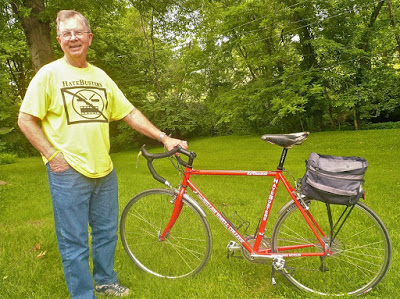 HateBusters has primarily worked in opposition to
hate directed toward people because of their race/ethnicity or because
of their religion and in support of those who have been victims of hate.
On Monday of this week, I had breakfast and a delightful conversation with Ed. I was impressed, again, with his mental vitality in spite of his debilitating physical illness and with his deep-seated desire to combat hate and prejudice and to create a world filled with people who live in harmony and practice mutual respect. Happy Birthday, Ed! The world badly needs more people like you. For further information:
** Most of Ed’s books are available for downloading at the website linked to above. Some books are directly related to MS and some to HateBusters, including a 1996 book with 42 issues of “HateBusters Bulletin.” -- Leroy Seat, Ph.D
Think Globally-Act Locally 2017 by Ed Chasteen
Dad took a job with United Gas Company and moved our family to Huntsville, Texas the summer I was 12 years old. A new high school was in the works, and Huntsville Junior High for the next two years became the high school. Thus did a building on the campus of the local teacher's college come to serve as our town's junior high. For grades seven and eight I went there and entered the new high school in the tenth. The new school was on a corner of two intersecting
residential streets. They were not heavily traveled, but our principal
took his job seriously and did not leave students unaided when walking
to and from school. He called me to his office one day to give me a red
vest, a hand-carried stop sign and told me I was to be the crossing guard,
a title and a function I cherished all through school.
From church during my high school years I had come to have the image of our life together painted in words by Jesus. Against this image and also from the church I had heard the words spoken by some of our leaders, a message distilled for me one Sunday morning as I was leaving church by a single sentence spoken by two deacons to each other. The first one said, “If them niggers try to come in this church, I'll beat 'em back with a baseball bat.” The other said, “Me, too.” I wandered onto our local college campus with no particular plan. No one in my family had ever been to college. I found myself after after a while walking around in the college bookstore. I scanned the shelves. A book jumped out at me: The Negro in America. I picked it up. Thumbed through. Read the first page. And it hit me! Here was somebody trying to explain intellectually the spiritual and social problem I had encountered at church and in school. I could be a crossing guard again. I took that book to the woman at the cash register. “What course is this book for?” I asked. “Race Relations.” She said. “What department?” “Sociology,” she said. “That's my major!” I said. That instantaneous selection of a major was confirmed in my mind when I discovered that the Sociology Department was housed in the very same college building where I had gone to junior high. When my fellowship from the University of Missouri required that I come to Kansas City I was told I could study any topic for a year while I worked to get my PhD. When I discovered that Kansas City had held a public vote in April of 1964 to decide if black people were to be allowed to use public accommodations, my topic was chosen. I spent a year interviewing people on all sides of the issue. When the year was past and I had my PhD, I joined the Sociology faculty at William Jewell College, teaching Race Relations and involving my students in the daily lives and problems of the friends I had made in Kansas City. Just a block west of campus stood Second Baptist Church. One Sunday morning in his sermon, Dub Steincross referred to the one square block occupied by our church as, “this little piece of God's good earth.” I loved that image and quickly expanded it to include my college. I went looking for goodness the summer of 1987. I spent 105 days riding my bicycle from Disney World in Florida to Disneyland in California, by way of Seattle, Washington. By myself. With no money. I found goodness. Everywhere. All the time. Mickey Mouse gave me a trophy. Disney dubbed me “The Pedalin' Prof from William Jewell College”. 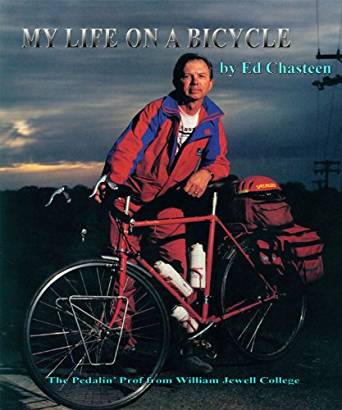 I had been back on campus a few weeks when the state of Louisiana elected a member of the KKK to their legislature. My Race Relations students started HateBusters. The Louisiana governor invited us to come help the state redeem itself. We took our bicycles and went. We began to be invited all over the country. Too many places. Too few of us. We needed focus. On my longest days on my cross country ride I rode 125 miles. So now back in Liberty, I drew a 125-mile circle around our town and called this little piece of God's good earth Greater Liberty, a place going north to Creston, Iowa and south to Carthage, Missouri; west to Manhattan, Kansas and east to Columbia, Missouri. More than a place, though, Greater Liberty is primarily a principle: We all have Greater Liberty than we know to rise above and beyond all the labels other people apply to us and we uncritically assume, labels that name our race, religion, nation, gender, class, sexual orientation, politics. We have the inherent ability to become World Class Persons, able to go anyplace at anytime and talk to anyone about anything and feel safe. We HateBusters now offer our goods and our services free of charge to all 104 county seat towns in Greater Liberty. Our book, How To Like People Who Are not Like You was called by a reviewer “profoundly simple and simply profound, a formula for building human beings”. To any victim of hate anywhere in Greater Liberty we offer any help they need. We never say no when asked to help. We never ask for money from those who need our help. I want every mayor, every city manager, every school superintendent, every high school principal, every newspaper editor, every TV or radio station, every Chamber of Commerce, every non-profit in all 104 Greater Liberty county-seat towns to know that HateBusters exists, that we are housed at William Jewell College, that we respond to any act of hate targeting a person's race, religion, sexual orientation or other social characteristic, that we give E-copies of our book, How To Like People Who Are not Like You to all who ask, that we have no dues and no meetings, that we never say no when asked to help and that we never ask for money from those who need our help. INVITE US AND WE WILL COME JOIN US AND WE WILL WIN HateBusters
|
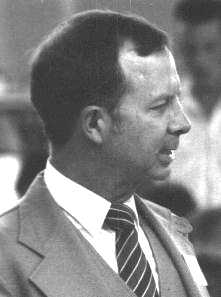 Ed
Chasteen, CRES amity shaman, finds ways to bring people together. After
30 years of teaching, Professor Chasteen left William Jewell in 1995, and
now offices his Hate-Busters organization, begun in 1988, at Central Baptist
Theological Seminary, and with his wife, Bobbie, runs Amity Associates
out of his home. Ed
Chasteen, CRES amity shaman, finds ways to bring people together. After
30 years of teaching, Professor Chasteen left William Jewell in 1995, and
now offices his Hate-Busters organization, begun in 1988, at Central Baptist
Theological Seminary, and with his wife, Bobbie, runs Amity Associates
out of his home.
Ed, also known as the “peddling prof,” has multiple sclerosis which his riding helps keep in check. This challenge made it especially meaningful when Ed was chosen as one of 35 “community heroes” to carry the Olympic torch to Atlanta when it passed through Kansas City in 1996. He was also chosen as a “Community Star” by The Kansas City Star. In 1976, when Ed was teaching cultural anthropology and race relations, he began the Human Family Reunions, multicultural potluck dinners to celebrate his students’ contacts with human diversity. They have since been held in a dozen other cities, including Tampa, San Antonio, and Sacramento. Ed is shown here at a 1988 Human Family Reunion. In 2006, he was one of only 200 to attend the White House Conference on Hate Crimes. His book, How to Like People Who Are Not Like You, has undergone ten editions since it first appeared in 1976. |
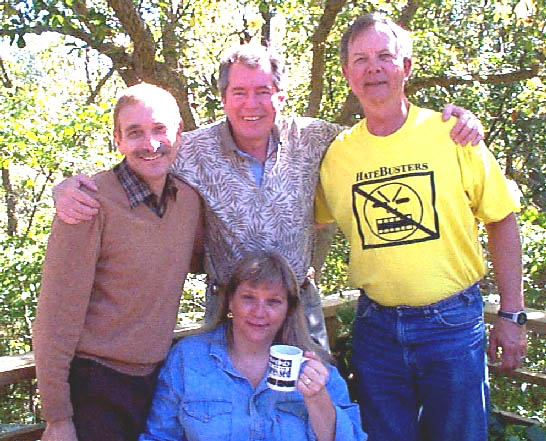
CRES staff members Vern, David, Ed, and Maggie on Maggie's veranda at an October staff meeting. email: HateBuster@aol.com |
|
I keep my mind on this impossible dream I have to rid the world of hate and teach people to like each other. My age is never a thing I think about. Here's something you would enjoy. Please pass the word to all your friends. Come all you who hunger and thirst to
We come today with open minds and warm hearts. Who's
right is the wrong
The Human Family Reunion is sponsored by HateBusters,
Barker Temple Church of
Let it never be forgot, that once there was a spot,
Maybe that's enough. Enough to buoy our weary souls
o'er troubled waters and
Bring a dish of your favorite food and come To tell us you are coming or to get more information
call Ed Chasteen,
The Van Project
(Visiting Area Neighbors)
In a court of law, only those with first-hand knowledge are allowed to testify. But in the court of public opinion, hearsay is often all we have. St. Charles
Parish
by Ed Chasteen The first day of spring has come as it should. Early morning clouds give way to soft sunlight. The wind gentles during the day to a warm breeze. First buds on flowering trees announce themselves in baby pink. Great expectations dance in all our minds as the 12 of us gather in Gene and Pat Cole’s living room, just a few blocks from Metro North Shopping Center. Sister Marilyn Peot has brought 10 other members of St. Charles Parish: Diane and Greg Smith, Mike and Joyce Rauth-Fears, Sister Aline Mohrhaus, Norbert and Shirley Duello and Glenna Carrol. I will be their driver. Promptly at 8:30 on this glorious morning we board our William Jewell College van. Fewer than 70 miles we will travel. By 6 PM we will return. But, oh, the wondrous day we will have. First stop, the home of Vern Barnet. Vern is Founder and Director of CRES (Center for Religious Experience and Study), a student and teacher of world religions, a passionate seeker of all that is sacred and all that would enrich our lives together. For half-an-hour in his living room, Vern shares his vision with us. Then Vern comes with us in our Van. All day he will share with us from his vast and compassionate knowledge of every faith as we make our way about Greater Kansas City to four faith communities that are at home here. The Hindu Temple at 6301 Lackman Road in Shawnee is our second stop. Kris Krishna is our host. After we remove our shoes, Kris ushers us downstairs where Sudha Bathina has prepared a short lecture and overhead transparences on the basics of Hunduism. She answers questions that we have. Members of the Temple have prepared refreshments for us before we go upstairs for a tour of the Temple sanctuary and an explanation of the statuary on display. Their priest describes for us the process by which one becomes a priest. Ananda Bhattacharyya and his wife Dipti are long-time HateBusters supporters and members of the Temple. They have just returned from a three-month visit to India. Ananda is a retired engineer. He also is here today to welcome us and share his knowledge. At noon we come to the Sikh Gudwara (Temple) at 6834 Pflumm Road in Shawnee, just a short drive from the Hindu Temple. The parking lot is full when we arrive, and people are entering the building. Women and girls wear flowing dresses in all colors of the rainbow. Men and boys wear suits and turbans on their heads. Charanjit Hundal is our host and meets us at the door. We have arrived just in time for a wedding. We take off our shoes, tie a scarf on our head and enter. Women are seated on the carpeted floor to our left; men to our right. The room is full already, but space is made for us to join the other guests. The ceremony and the songs are all in Punjabi. Those near us do not understand the language, but they know what’s happening. They whisper to some of us so we will know. After an hour, we adjourn downstairs for a delicious vegetarian Indian meal. The aromas and the spices give an Eastern ambiance. We get our meals and take our places on the floor with beautiful food before us. Charanjit explains that chairs and tables are not used in the gudwara. “Sitting on the floor, we are all equal. No one is elevated above another.” The children made it through the mandated quiet of the wedding. Now their exuberant noises and movement make it hard to hear Charanjit as he explains Sikhism to us. Pat is seated next to him. She hears it all and gives us a near literal recitation when we get to the van and before we leave the parking lot. It’s one-thirty when we leave. Across Greater Kansas City on Shawnee Mission Parkway, we skirt Country Club Plaza on the south and come to Wornall Road. A left turn brings us three blocks later to 47th Street (AKA Brush Creek and Emanuel Cleaver Blvd.), where we turn right and over to Troost Avenue. Another left and we are quickly at Al-Inshirah Masjid (Mosque), just in time for our two o’clock appointment. Imam (minister) Bilial Muhammed is our host. We remove our shoes just inside the door and enter the place of worship. Bilial has invited some of his members to join us: Majeeda and Aasim Baheyadeen, Shaeer Akhtab, Robert Rashad, Abdus Sabir Taalib Din Muhammed and Zarrieff Osman. We all seat ourselves in a circle. Others join us as the imam and his members explain Islamic belief and practices to us. As we conclude our discussion and answer period, the men form a line and demonstrate for us the method and meaning of their required daily prayers. In an adjoining room, the women have prepared refreshments for us, giving us all a few minutes for talk of ordinary things that neighbors might discuss. Then Vern arranges us for another of the photographs he has taken at every stop. Photographs that will appear in the next edition of the CRES newsletter. Llama Chuck Stanford has just day before yesterday returned from several week’s study in India. Jetlag is still a problem. I had thought we could not visit the Rime Buddhist Center in his absence. I had instead asked Vern to take us on a quick tour of the Nelson-Atkins religious art, a tour he regularly gives. But Vern and Chuck are good friends. They have arranged for Matt Rice, Chairman of the Board at the Rime Buddhist Center, to meet us there at four o’clock for a tour and discussion. Rime Buddhist Center is located just off I-35 near the 20th Street exit in a former church building. There are several schools of Buddhism. The word “Rime”, pronounced ree-may, indicates that this center does not follow any particular school but is inclusive of them all. Matt leads us through the building, stopping to explain the significance of every object. He invites us to come again at any time to learn more. By six o’clock we are parked again in the Cole’s driveway, back where we started nine and one-half hours ago. It’s likely that never in our lives have we spent a day immersed in religious thought so seemingly different yet so fundamentally similar. Asking in various ways a similar question—What does God require of me and how should I live? –these faiths have arrived at answers that seem so different. I am reminded when I think of these obvious differences that to the unaided eye the earth seems flat. All day I have reminded those who travel with me and those we visit that our purpose is to form friendships with people of other faiths. If we know by name people of other faiths we can serve as bridges when troubled waters flow between us. When rumors fly that demean a faith, we can come to our friends for facts we trust. By being friends across faith lines we can help all our faiths not simply to endure one another but to endorse each other. As monopoly is bad for an economy so also is it bad for a religious faith. In economics monopoly leads always to higher prices for inferior products. With no competition there is no incentive to improve the product and no reason not to raise the price. The same is true in the religious arena. Any one of the world’s religions if given unquestioned authority would produce an inferior product at too great a price. Religious diversity is essential if the full range of human spiritual needs is to be fully satisfied. A free spiritual marketplace benefits each individual faith and should, therefore, be endorsed by followers of every faith. My chosen profession is Ambassador to Other Communities
of Faith. I am a Christian. A Baptist. I am a faithful member of my local
church. Because my faith is precious to me, I want to meet and know people
of other faiths. I want to visit with them and become a friend. I do not
want to join them or to change them. I want us all to be ourselves and
encourage one another in our faiths. I invite others to join me in this
effort.
Comments of those who visited faith communities today “What an enlightening day, Ed! We so appreciated the thoroughness of your preparation; and your sharing of your philosophy about what brought us together--the key point being to consider how we are alike, rather than how we are different. Like the Hindus, we believe Catholicism is a way of life. With the Sikhs, we believe all men are created equal, there is no caste system. What warm hospitality we received from the Muslims. Their emphasis on frequent communion with God through prayer rings true with us. The Buddhists' emphasis on meditation and its integration in our daily lives is a very important aspect of our Catholic spirituality also. Having Vern Barnet accompany us on each of the visits was just icing on the cake! Thanks again, Ed, and God bless for making this a very special day.” Sincerely, Shirley & Norbert Duello
|
|
in Greater Liberty 2017 from Ed Chasteen aka Pedalin' Prof The billboard on campus that summer showed the route I rode on my bicycle from Orlando to Seattle to Anaheim. By myself. With no money/. Looking for goodness. And finding it. Took me 105 days. On my longest days I rode 125 miles. So when I was back I drew a 125 mile circle around our town called Liberty. I dubbed this little piece of God's good earth, Greater Liberty, meaning to call attention to the Greater Liberty we all have to live beyond all the names other people know us by. My hope is to find a friend in every Greater Liberty faith community and to encourage others to come with me. I propose a class for faith communities located in Greater Liberty. An on-line class, with few, maybe no, actual visits. But! Close enough that should we wish, a visit//visits might easily be arranged. I ask members of Greater Liberty faith communities to contact me on line and sign up for this class. I will then pair you with a member of another faith community. This new identity will be someone of another faith who lives nearby. Let us call this The Greater Liberty Class. Both members of every pair will hold seven on-line conversations using the seven sets of questions I provide. Each will then write the life story of the one with whom you are paired. The story will be written in first person” “My name is (…...)” Each member of the pair will submit your story to the other for possible additions and/or corrections. And then to me. After each online conversation, each member of the pair will tell me by email what you learned about the person you are becoming. When the seven conversations have been completed, each member of the pair will write the story of your new identity as you have learned it through the seven sets of questions. This class will follow the academic calendar: fall semester September-December; spring semester January-April. In May at William Jewell College all pairs will be invited for a Human Family Reunion honoring those who by their work as pairs are now recognized as World Class Persons, able to go anyplace at anytime and talk to anyone about anything and feel safe. Students may sign up for either the fall or the spring semester. The seven sets of questions are designed to be completed in one semester. I know of no better way to deepen and widen one's own faith than by delving into another, and no better way of delving than by spending a few weeks as someone of another faith. One of my very good friends is Yahya Furqan, a Muslim imam. We have traveled the country together. We have visited in each others homes. Yahya says he is a better Muslim because he knows me. I am a better Christian because I know him. Neither of us have even thought of trying to convert the other. I am now contacting some of my longtime friends in the various faith communities in the area to ask them to help me enlist their folks in this quest to both find friends and build bridges. And to all who may happen to read this letter, I ask you to please join me. Sign up for Greater :Liberty.. Email: hatebuster@aol.com The Pedalin’ Prof
www.greaterliberty.org www.hatebusters.com hatebusters.wordpress.com
BECOMING A WORLD CLASS PERSON Right Here in Greater Liberty An Invitation to Seven Conversations from Ed Chasteen, PhD The Pedalin' Prof from William Jewell College and Ambassador from Second Baptist Church to Other Communities of Faith
Text and Talk Our focus is not on books and printed words but on individual persons and their spoken words. I ask only that you read one little book, just 144 pages. The book is called How To Like People Who Are not Like You. A reviewer called this book “profoundly simple and simply profound, a formula for building human beings.” I wrote the book. Download the book free of charge, Just go to www.hatebusters.com . Our moving closer to World Class Person is built around the seven conversations we will have with the person we are becoming, using the seven sets of questions listed below. After each conversation, you will email to your person and to me the words you have written describing the words your person spoke to you. At the end of week #7 you will email to your person their biography as they have told it to you. You will ask for their approval. When you have it, you will email the completed biography to me. When our spoken journey ends after four months,
we will gather at William Jewell College for a Human Family Reunion. We
will all meet each other and each of us will be recognized as a World Class
Person.
Questions to ask the person you are becoming You may hold these conversations on line, in person
or by phone. I ask that you talk to one another one to one, with no other
person taking part. I hope you can arrange at least one conversation in
person, just the two of you. I ask that you read How To Like People Who
Are not Like You as background and mind set. An E-copy of the book is available
at no charge to everyone at www.hatebusters.com
1st. Conversation Name of parents, grandparents, brothers, sisters. Where do they all live now? Where did you grow up? Where did you go to school? What are some of your earliest memories? What was it like growing up?
2nd Conversation How would you describe your family? What is the role of the husband and father? What is the role of the wife and mother? What do you like to eat? What is your very favorite food? What kind of jobs have you had? What is your present occupation?
3rd Conversation What is your religious faith? What religious organizations do you belong to? How often do you participate in activities with these organizations? Could you tell me what you believe about how your faith relates to other faiths? Is your faith related in any way to the food you eat? How important to you is your faith?
4th Conversation How do you think the different religions and races in America relate to each other? How do you think they should relate to each other? What are the important days in the year to you? How do you celebrate the important days in your life? How would you describe the way you live your life?
5th Conversation What are the important books and other writings that have shaped your life? What do you hope will happen in your private life over the next three years? What do you think will happen in the world in the next three years? What would you say is your greatest fear? What would you say is your greatest joy?
6th Conversation How would you describe America? What do you think America’s role in the world should be? How would you like to be remembered?
7th Conversation What does your faith teach about how we should live our lives? What does your faith teach about life after death?
Where our minds and hearts have come These are the words I have said to those who have
lived as another for a few weeks.
Thank you for letting me live as you for these weeks. This is your life as you have told it to me. Each week for seven weeks you have told me about your life and I have emailed you what I wrote. Now that our class is ending and I have completed your biography and emailed it to you, would you please make any corrections and/or additions and give me your permission to email your authorized biography to Ed, our conductor. Then at our Human Family Reunion you and I will meet and both be inducted into the Order of World Class Person. We human beings are gregarious creatures, meaning that we need to be with other people. We join others in social, civic, religious, political, athletic, artistic, hobby and other groups too numerous and varied to number. We spend time, talent, energy and money in their name. So engrossed in our groups can we become that we come to think that those who are not members with us are bad people. Mutual distrust and suspicion arise between groups, giving rise to chronic tension and causing the smallest misunderstanding to be life threatening. What the world needs now is a group of people rooted in their own small groups but equipped also with wings, allowing them flight all over the world as invited guests among those whose only shared membership is human being. Such persons we dub World Class Persons, able to go anyplace at anytime and talk to anyone about anything and feel safe. None of us ever get completely there. But some move so far in that direction that slower ones look to them for direction. Together for these weeks we have been traveling
closer to that time when we can go anyplace at anytime and talk to anyone
about anything and feel safe. We are becoming World Class Persons. Responsible
now for leading others.
THE BOOK How To Like People Who Are Not Like You (c) 2009 by Ed Chasteen
CONTENTS Dedication Attention The Book in Brief Chapter 1 Why Bother? Chapter 2 Learn to Like Yourself Believe these things My Life Has Meaning And Purpose I am unique I'm as good as anyone What other people think of me is less important than what I think My self worth is based on who I am, not what I can do What I want Is less important than what is good for me Owning things only seems to make me more attractive Think about these things How lucky I am My strengths and abilities Other people's problems Finding peace of mind Making the most of today Something beautiful My death Do These Things Read good books Develop a skill Talk to other people, and listen to what they say Achieve the proper pressure Take part in projects designed to help other people Exercise Travel Chapter 3 Step Two--Learning to Like People Who Are Like You Believe these things I am a part of my people I am as valuable to my people as my people are to me My people's motivations are as proper as my personal motivation I will get from my people as I give to my people I will find myself through knowing my people My people know me as imperfectly as I know my people My people will be increasingly important to me as I grow older Think about these things Finding ways to know your people better Why your people do what they do Supporting your people Who are your people? How are you and your people alike? How are you and your people different? Who tells you how to relate to your people? Do these things Join them Volunteer for extra duty Learn the history and values of your people Talk it up Go to bat for your people Becoming a loving critic of your people Share your people's fate Chapter 4 Step Three--Learning to Like People Who Are Not Like You Believe these things Their ways make as much sense as mine But for accident of birth, I could be one of them Who's right? is the wrong question I may never agree with them, but I can relate to them They are as attached to their way as I am to mine The world would be a poorer place if they did not exist Only by understanding Them do I come to understand myself Think about these things What are the really basic differences between us? How and when did our differences start? How am I like them? Are they as uncertain about how to relate to me? What is really happening in my encounter with Them? How will my children and theirs relate to each other? What does knowing those who are not like me tell me about myself? Do these things Learn another language Visit ethnic communities; attend their place of worship Eat their foods Study other cultures Put yourself in uncomfortable situations Feel good about not trying to change Them Don't pretend to understand Chapter 5 Where To Take the Steps Your private world Your person Your family Your public world The religious arena The political arena The social arena The cultural arena The world arena Chapter 6 The Three Step Week Give us this day Identification Day Suspension Day Affirmation Day Chapter 7 The Human Family Reunion The Reunion begins Does the caged bird sing? Class provides new life Appendix: The Three Step Test Part A Part B Interpretation of responses Scoring Now that you have read the book World Class Person Signing up for these Conversations To participate in these seven conversations send an email to me at hatebuster@aol.com. Tell me you want to be paired with a person of another faith to hold these seven conversations and write the story of the one with whom you are paired,. Those who hold the seven conversations and proceed
as described below will achieve the distinction of World Class Person and
will be inducted into the Order of World Class Person at our Human Family
Reunion to be held at William Jewell College in Liberty.
A Message To My Students from Ed Chasteen
This is what I would say to my class at William
Jewell College as we neared the end of our time together in a class much
like this. Reading it will help you understand who I am and where I hope
to lead us.
Class, I believe that each of you has a spark of genius. I seek to ignite that spark and start a fire. A fire that might warm a cold-hearted world. A fire that might light the way. A fire that draws people out of the dark. My fictional hero is Don Quixote. Don Quixote says, “Too much sanity may be madness. And the greatest madness of all may be to see the world as it is. And not as it should be.” I see the world as it should be. It should be a place where all people are friends. A place where all people feel safe. If the fact the world is not this way causes me to abandon my vision of a better world, then the bad guys have won already. Evil in the world is all the more reason to want to be a World Class Person, able to go anyplace at anytime and talk to anyone about anything and feel safe. Don Quixote’s friends think he is crazy. They tell him, “Wickedness wears thick armor.” He responds, “And for that you would have me surrender? Nay, the enchanter may confuse the outcome ten thousand times. Still must a man arise and again do battle. For the effort is sublime.” Indeed it is. It’s an effort I must make. Nightly news and morning headlines that assault my sense of peace and justice goad me to greater effort. If the barbarians are to win, it will not be because I surrendered. I will not become like them in a misguided effort to defeat them. If I am to defeat them, it will be because I took the high road. Early in Man of LaMancha, Don Quixote comes to an old house beside a dusty road. He thinks he has come to a castle. Inside he meets the most beautiful woman he has ever seen. He falls to his knees. “What is your name, my lady?” He asks. “Off your knees, you fool. My name is Aldonza. And I’m no lady.” Indeed she is not. This house is a place where mule drivers come for the night. To rest and eat and be entertained. Aldonza waits on them by day. And by night. She is no lady. “No, my lady, your name is not Aldonza. Your name is Dulcinea.” Don Quixote says. She curses him and throws a dirty dishrag at him. He takes it as a token of her affection. He leaves. Several times in the story he comes back. Every time he calls her Dulcinea and treats her as a lady. Every time she is angry and unkind to him. Near the end of the story, Don Quixote is dying, delirious and distant from this place. She hears about his condition. She goes to find him. She forces her way into his room. She takes his hand. “My lord,” she says. “Who is it?” He asks. “Why you know who I am. You called me by name and changed my life.” “No, my lady, who is it?” He asks. And she says, “My name is. . . . Dulcinea.” She now sees herself as he has seen her all the time. And that’s the way I see the world. I will call it Dulcinea until one of two things happens. Either it becomes what I have always seen it to be. Or it does me in. I will always expect to find friends wherever I go. I will always look for that spark of goodness and genius I see in all people. Nothing will ever persuade me that my dream is impossible. So, dear students, I have invited my friends into our classroom this semester to visit with us about their childhoods and their faith: Assembly of God, Baha’is, Baptists, Buddhists, Catholics, Church of Christ Scientists, Hindus, Jews, Muslims, NAINs, Native-Americans, Pagans, Presbyterians, Sikhs, Sufis, Unitarian Universalists, Unitys, Vedantas, Zoroastrians. All of these dear folks live just a few minutes by car from our campus. They are all Americans. They are our neighbors. We all endorse one another. We all share a spiritual quest. By knowing one another and becoming friends, we all become our best selves and most surely find our individual and common purpose. I long for all of you to become World Class Persons. You have trusted me to lead you in this way. We have completed much of our work together and done it well. In just two weeks comes our Human Family Reunion. All of our classroom visitors will return for a final time with us. Each of you will present to the class a 10-minute version of the autobiography you have prepared as the classroom visitor whose identity you assumed. As a class our work has been superb. You have done everything I asked of you with enthusiasm, energy, clear thinking, good effort, great reporting. Individually and together, we have gone beyond ourselves. With a ways yet to go and work still to do, we are all on track for the best possible grade. I will not hesitate even for an instant to award A’s to the entire class. Please give me that opportunity by giving me your all during this month of April as we plan and hold our Human Family Reunion, visit our person’s home and place of worship, present our autobiographies and write our final essay. I will not teach you again. I will remember you and the wondrous things we did together. But I have promises to keep and miles to go before I sleep. So do you. Up the road—sometime, somewhere—we may meet again on our journey to World Class Personhood. I hope so.
Your friend and teacher
Ed |